Payment Orchestration: When Multiple Processors Help and When They Hurt
Payments Operations · February 6, 2026 · 9 min read
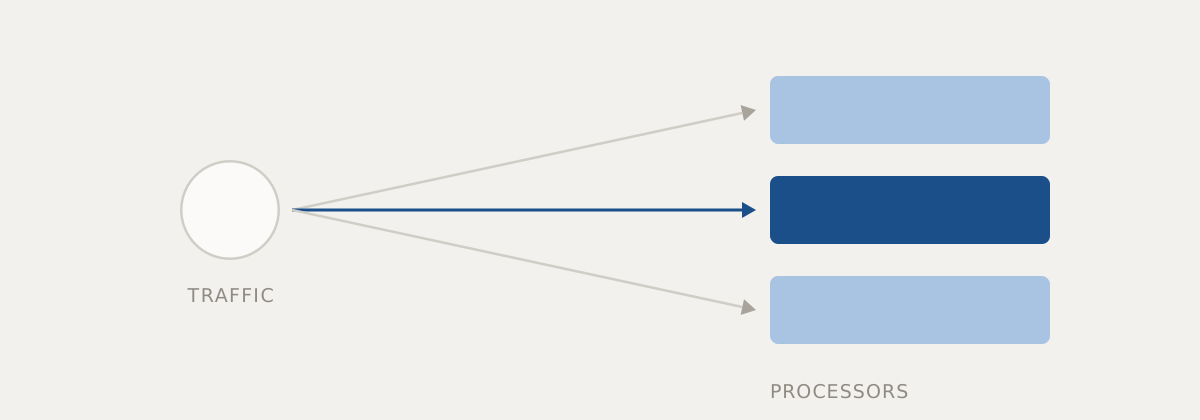
Payment orchestration is one of the few genuinely strategic decisions in payments architecture, and it is routinely made for the wrong reasons. Teams adopt it because a competitor did, because a vendor made a compelling pitch, or because a single outage created organisational trauma. Then they discover that running two processors is not twice the work — it is considerably more, concentrated in areas nobody scoped.
Done at the right time for the right reasons, orchestration delivers real value. Done prematurely, it consumes engineering capacity that would have produced more return spent on authorization optimisation with a single provider.
What orchestration actually provides
An orchestration layer sits between your application and multiple payment providers, offering a unified interface and a routing engine. The value propositions are distinct and worth separating, because most teams only need some of them.
Redundancy. If one processor degrades, traffic shifts to another. For businesses where checkout downtime translates directly into lost revenue, this is the most defensible justification.
Local acquiring. Processing through an acquirer in the customer’s region rather than cross-border improves authorization rates and reduces interchange and cross-border fees. Few single providers offer optimal local acquiring in every market a global business operates in, making this the strongest genuine driver of multi-processor architecture.
Method coverage. Local payment methods — regional wallets, bank transfer schemes, cash vouchers, instalment providers — are frequently unavailable through a single global processor. Selling in markets where a local method dominates requires connecting to it.
Commercial leverage. A merchant that can shift volume between providers negotiates from a stronger position than one facing a costly migration. This is real, though often overstated: switching costs remain substantial even with orchestration, and providers know it.
Routing optimisation. Directing transactions to whichever provider performs best for a given card type, geography, or amount band. This is the most heavily marketed benefit and the hardest to realise, because it requires enough volume per segment to distinguish signal from noise.
The costs nobody scopes properly
The complexity of orchestration lives almost entirely outside the authorization path, which is why estimates come in low.
Reconciliation multiplies. Each provider has its own settlement file format, timing, fee structure, and reporting quirks. Finance must reconcile every provider independently and then consolidate. This is the single most common source of unplanned work.
Refunds are provider-bound. A refund must be issued through the provider that processed the original charge. Your data model must track this permanently, and it must survive provider migrations, contract terminations, and the eventual deprecation of an integration.
Disputes are provider-specific. Each provider has its own dispute workflow, evidence format, deadlines, and API. Operations teams must learn all of them, and dispute handling cannot be unified as cleanly as authorization.
Tokenisation fragments. Card credentials stored with one provider are not portable to another without a migration process. Without network tokens or an independent vault, routing a returning customer to a different provider means you no longer have their credential. This single issue defeats many naive routing strategies.
Behaviour differs subtly. Decline code mapping, partial authorization support, 3-D Secure implementation, retry semantics, and webhook delivery guarantees all vary. An abstraction layer hides these until it cannot, and the leaks appear as edge-case bugs in production.
Reporting fragments. Consolidated payment analytics require normalising data from providers that categorise things differently. Every metric needs a canonical definition and a per-provider mapping.
Vendor risk transfers rather than disappearing. If you use a third-party orchestration platform, it becomes a critical dependency in your payment path. You have added a component whose outage affects all providers simultaneously — which is precisely the risk orchestration was meant to remove.
A readiness test
Before committing, most teams benefit from answering a few questions honestly.
Have you exhausted single-provider optimisation? Network tokens, correct transaction indicators, complete data submission, intelligent retries, authentication tuning, and local acquiring through your existing provider where available. These typically deliver larger gains than routing, at a fraction of the complexity. Teams that skip this step and jump to orchestration frequently find their authorization rate barely moves.
Do you have enough volume per segment? Routing decisions require statistically meaningful performance differences. If a segment sees a few hundred transactions monthly, you cannot distinguish provider performance from noise, and you will optimise into randomness.
Is your reconciliation already solid? If single-provider reconciliation is manual, fragile, or chronically behind, adding a second provider will not improve it. Fix the foundation first — this is the most reliable predictor of whether an orchestration project goes well.
Do you have an owner? Multi-provider payments needs a team or at minimum a dedicated person owning routing configuration, provider performance monitoring, and reconciliation health. Distributed ownership means nobody notices when a routing rule silently degrades.
Is the driver real? Genuine multi-market local acquiring needs, required local payment methods, or a documented revenue impact from outages all justify the work. Wanting better rates, in isolation, usually does not — negotiate first.
Build, buy, or hybrid
Three approaches exist, each with a defensible case.
Build your own layer if payments are core to your product, you have engineering capacity to sustain integrations indefinitely, and you want no third party in the transaction path. The ongoing cost is integration maintenance forever, as every provider changes APIs on their own schedule.
Buy a third-party orchestration platform to get many pre-built integrations, a routing engine, and unified reporting quickly. Accept a new critical dependency, per-transaction cost, and constraints on customisation. Evaluate the vendor’s uptime history and failure modes with the seriousness you would apply to a processor.
Hybrid is the most common pragmatic outcome: a primary processor handling the large majority of volume with direct integration, plus a secondary for failover and specific geographies or methods, with a thin internal abstraction. This captures most of the redundancy and local acquiring benefit without the full complexity of true dynamic routing.
Implementation guidance
Teams that execute this well tend to follow a similar sequence.
Start with failover, not optimisation. Get a second provider working as a fallback for outages before attempting performance-based routing. This delivers the clearest benefit and builds operational familiarity.
Adopt network tokens or an independent vault early. Credential portability is the prerequisite for meaningful routing. Without it, routing applies only to new customers, which is a fraction of volume for most businesses.
Define canonical data models first. A single internal representation of a payment, refund, dispute, and fee, with per-provider mappings. Retrofitting this after two integrations exist is painful.
Make routing rules explicit, versioned, and auditable. Routing logic buried in application code becomes unknowable within months. It should be configuration you can inspect, change, and roll back, with a record of what changed and when.
Instrument per-provider performance from day one. Authorization rate, latency, error rate, and cost by segment, per provider. Without this, routing decisions are guesses.
Test failover regularly. A failover path that has never been exercised will not work during the incident it was built for. Run deliberate drills.
Plan reconciliation before launch. Not after the first month-end close reveals the gap.
The honest summary
Orchestration is infrastructure, and infrastructure is justified by scale and by specific constraints, not by aspiration. A business processing meaningful volume across several countries with local acquiring needs and genuine outage exposure should almost certainly run multiple providers. A business processing in one or two markets through one provider will nearly always get more return from optimising what it already has.
The most expensive version of this decision is adopting orchestration to fix an authorization rate problem that was actually caused by missing network tokens and incorrectly flagged recurring transactions — spending months on architecture to solve a problem that a fortnight of transaction hygiene would have addressed.
Diagnose first. Architect second.