Authorization Rate Optimization: The Cheapest Revenue You Are Not Collecting
Payments Operations · February 10, 2026 · 10 min read
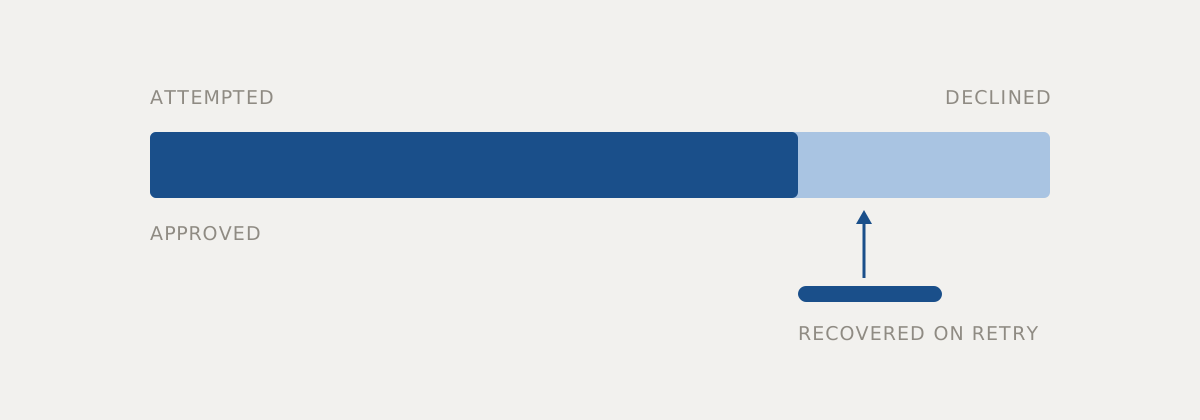
Most companies spend heavily to bring a customer to the point of payment and then lose a meaningful fraction of them to a decline nobody investigates. If your authorization rate is 85 percent, roughly one in seven customers who intended to pay you did not. Some of those were genuinely fraudulent or genuinely out of funds. Many were not.
Authorization rate optimization is unglamorous, quantitative, and among the highest-return work available to a payments team. A one-point improvement on a hundred million in attempted volume is a million in recovered revenue with no acquisition cost attached.
Understand what you are measuring
Before optimising anything, define the metric precisely, because vague definitions hide the problem.
Authorization rate is approvals divided by attempts. But which attempts? If you count retries as separate attempts, your rate looks worse while your outcomes improve. If you count only first attempts, you miss recovery performance. Serious teams track both: first-attempt approval rate and eventual approval rate per payment intent.
Then segment relentlessly. A single blended number is nearly useless. Break it down by issuer, issuer country, card brand, card type, transaction type, currency, amount band, customer tenure, and — for subscriptions — billing cycle number. Problems in payments are almost never uniform. They concentrate in specific issuer-plus-condition pockets, and the pockets are invisible in aggregate.
Read the decline codes properly
Issuers return response codes that fall into three practical buckets, and treating them identically wastes both money and goodwill.
Hard declines are terminal: stolen card, closed account, invalid card number, do not honour with a fraud indicator. Retrying these is pointless, mildly abusive of network rules, and increasingly penalised through per-attempt fees.
Soft declines are conditional: insufficient funds, issuer unavailable, exceeds withdrawal limit, transaction not permitted, generic processing error. These are the recoverable pool and the entire basis of retry strategy.
Authentication-required declines are a distinct case, common in Europe under strong customer authentication rules, where the issuer is not refusing but demanding a step-up. Treating these as failures rather than as an instruction to authenticate destroys conversion outright.
The uncomfortable reality is that decline code quality varies significantly across issuers. “Do not honour” is a catch-all that can mean anything from suspected fraud to a risk model having a bad day. This is why observed retry outcomes matter more than code taxonomy: measure what actually recovers, per issuer, rather than trusting the label.
The high-return fixes
Network tokens
Replacing stored card numbers with network-provisioned tokens is consistently the single largest structural lever for recurring and stored-credential merchants. Tokens survive card reissuance, carry richer trust signals to the issuer, and are treated more favourably by issuer risk models. Reported approval lifts commonly fall in the low single-digit percentage points, and the same change frequently improves interchange qualification.
Account updater and credential lifecycle
Cards expire, get reissued after breaches, and change numbers. Account updater services push those changes to merchants before the failure happens. Combined with proactive expiry monitoring, this eliminates a category of involuntary churn that most subscription businesses simply absorb as normal attrition.
Correct transaction indicators
Networks define specific flags for initial versus subsequent stored-credential transactions, merchant-initiated versus customer-initiated transactions, recurring payments, instalments, and unscheduled top-ups. Sending these correctly materially changes issuer treatment — a merchant-initiated recurring charge flagged as a fresh card-not-present transaction looks far more suspicious to a risk model than it should.
This is pure engineering hygiene with no downside and it is very commonly wrong in production.
Data completeness
Send everything the issuer can use: full billing address for address verification, card verification value where the transaction type permits, accurate merchant descriptor, device and session data, and 3-D Secure authentication results when available. Issuers approve what they can evaluate. Sparse requests get conservative decisions.
Merchant descriptors
An unrecognisable descriptor on a statement generates disputes, and disputes feed back into issuer risk models that then decline more of your future traffic. Clear, searchable descriptors that match the brand the customer actually bought from are a fraud-and-authorization intervention disguised as a formatting detail.
Intelligent retries
Naive retry logic — try again tomorrow, then the day after, then give up — leaves substantial recovery on the table and irritates issuers.
Effective retry strategy has several properties.
It is code-aware: only soft declines are retried, and different codes get different treatment. Insufficient funds rewards patient retries timed to likely payroll cycles. Issuer unavailable rewards a fast retry within minutes.
It is issuer-aware: recovery curves differ substantially between issuers, and the optimal schedule is learned from observed outcomes rather than assumed.
It is timing-aware: attempt timing relative to typical salary deposit dates, avoidance of month-end congestion, and local business hours all move recovery rates measurably in consumer subscriptions.
It is bounded: network rules limit retry counts for certain declines, and per-attempt fees mean unlimited retrying has real cost. Cap attempts and stop when the expected recovery value falls below the attempt cost.
And it is paired with communication: for subscription businesses, a well-timed message asking the customer to update their card recovers accounts that no automated retry can. Dunning is part of authorization strategy, not a separate marketing concern.
Authentication as a conversion lever
In markets with mandatory strong customer authentication, authentication design is authorization design.
Use exemptions and delegated authentication where the rules permit: low-value exemptions, transaction risk analysis exemptions, trusted beneficiary listings, and merchant-initiated transaction exclusions. Every avoided challenge is friction removed.
When a challenge is unavoidable, make it good: native app authentication over redirect flows, mobile-optimised, with clear branding so customers do not abandon out of suspicion that they have been phished.
And instrument the authentication funnel separately. A high authorization rate on authenticated transactions means nothing if half of customers abandon during the challenge. The metric that matters is end-to-end completion from intent to approval.
Routing and redundancy
Merchants operating at scale across multiple geographies gain from local acquiring — processing through an acquirer in the cardholder’s region rather than cross-border. Domestic transactions approve at higher rates and cost less in interchange and cross-border fees. This is one of the largest available lifts for international businesses and one of the most operationally involved to implement.
Multi-processor setups additionally allow failover during outages and retry across providers, where a decline through one path is sometimes approved through another because of differing connectivity, tokenisation, or acquirer risk configuration. The cost is genuine complexity in reconciliation, refunds, and reporting, so this is a scale decision rather than a default.
Do not optimise into fraud
Every authorization lift must be evaluated jointly with fraud and dispute rates, because the easiest way to raise approvals is to accept transactions you should have refused.
Track approval rate, fraud rate, dispute rate, and false positive rate as a single dashboard with one owner. When a change lifts approvals by half a point and disputes by a tenth, do the arithmetic on chargeback cost, fee exposure, and network monitoring programme thresholds before celebrating. Breaching a network fraud monitoring programme is expensive and slow to exit.
An operating cadence
Teams that sustain gains rather than achieving them once tend to run something like the following.
Weekly, review authorization rate by issuer and flag deviations against a rolling baseline — this catches issuer model changes and connectivity problems within days instead of quarters.
Monthly, review decline code distribution, retry recovery performance, and authentication funnel completion, and rebalance retry schedules against observed data.
Quarterly, audit transaction indicator correctness, token coverage, and data completeness, because these regress silently as product teams ship new checkout paths.
Continuously, A/B test one change at a time with enough volume to reach significance, and resist the urge to ship five improvements simultaneously and attribute the result to whichever one you liked best.
Authorization optimisation has no finish line. Issuers change models, fraud patterns shift, regulations evolve, and your own product adds new payment paths. But the compounding return is real, and it is available to any team willing to treat declines as a measurable engineering problem rather than an unfortunate fact of life.