Open Banking and the Rise of Account-to-Account Payments
Payments Infrastructure · January 5, 2026 · 10 min read
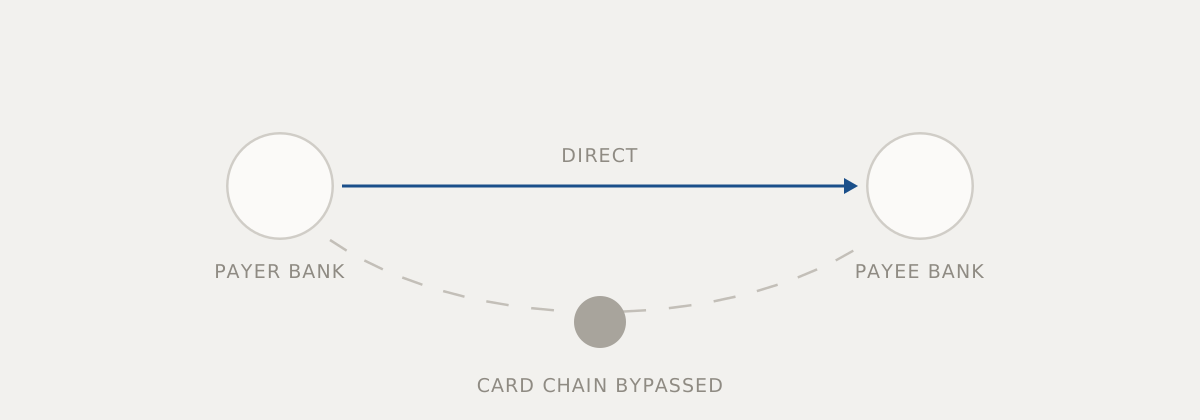
Account-to-account payments should, on paper, have taken over retail commerce years ago. They move money directly between bank accounts with no card network in the middle, at a fraction of card cost, with instant settlement and no chargebacks. Every merchant economics argument favours them.
In Brazil and India they did take over, at remarkable speed. In much of Europe and North America they remain a minority method after years of regulatory encouragement and substantial investment. That divergence is the most instructive natural experiment in modern payments, and it says something uncomfortable about how payment adoption actually works.
Two different things called open banking
Precision helps, because the term covers two capabilities with very different maturity.
Data access allows a licensed third party, with customer consent, to read account information: balances, transaction history, account ownership. This underpins account aggregation, affordability assessment, accounting automation, and personal finance tools. It has been broadly successful and is now infrastructure that thousands of products depend on.
Payment initiation allows a licensed third party, with customer consent, to instruct a payment directly from the customer’s bank account. This is the capability that competes with cards, and it is where progress has been far more uneven.
The distinction matters because open banking’s data side is genuinely mature while its payment side is still fighting for relevance in most regulated markets.
Why Pix and UPI succeeded
Brazil’s Pix and India’s UPI achieved adoption that European open banking payments have not approached. The reasons are structural and, importantly, replicable only under specific conditions.
A central authority built the rail and mandated participation. Brazil’s central bank built Pix and required large institutions to join. India’s UPI was built by a bank-owned utility with regulatory backing. This eliminated the coordination problem that kills payment networks — nobody had to wait for competitors to adopt before it was useful.
The user experience was standardised, not left to each bank. A single, consistent flow — a QR code or an alias — worked identically everywhere. Compare this with fragmented per-bank authentication journeys, where a merchant’s conversion rate depends on which bank the customer happens to use.
Pricing was set to make adoption inevitable. Pix is free for consumers and near-free for most merchants. No amount of merchant enthusiasm can overcome consumer indifference; free and instant produced consumer demand directly.
There was a large, underserved base. Both markets had substantial populations without deep card penetration and significant reliance on cash. The new rail was not asking people to abandon a well-loved incumbent; it was serving a genuine gap. Cash was the competitor, and Pix beat cash on every dimension.
Instant settlement, always available. Continuous availability with immediate finality made the product feel categorically different from existing bank transfers.
The lesson is that these were not market-driven disruptions. They were public infrastructure projects with mandated participation, standardised experience, and subsidised pricing. Markets where regulators required banks to open interfaces but left product design, pricing, and experience to competing commercial actors did not produce the same outcome — and could not have.
Why European progress has been slower
Europe’s regulatory framework opened payment initiation years ago, and the ecosystem has grown, but card and wallet payments still dominate e-commerce checkout in most member states. Several causes compound.
Inconsistent bank interfaces. Implementation quality varied dramatically. Some banks built reliable, fast authentication; others produced slow, unreliable flows with frequent failures. From a merchant’s perspective, a payment method whose conversion rate depends on the customer’s bank is difficult to promote.
Redirect friction. Many flows required leaving the merchant’s checkout, authenticating in a banking app or web interface, and returning. Every additional step costs conversion, and cards had spent two decades removing steps.
No consumer incentive. Cards offer rewards, purchase protection, chargeback rights, and deferred payment. Paying directly from a bank account offers the consumer none of these. Merchants save money; consumers gain nothing and lose protections. Absent a price signal passed to the consumer, rational consumers keep using cards.
Weak dispute rights. Chargebacks are a genuine consumer benefit. A payment method without an equivalent recourse mechanism is a harder sell for anything other than trusted merchants.
A functioning incumbent. European card payments work well. Displacing a good-enough incumbent requires being dramatically better, not marginally cheaper for the other side of the transaction.
The revised regulatory framework and the emergence of standardised instant payment schemes address some of these — mandating better interface performance, requiring instant payment availability, and pushing toward consistent experiences. Whether that closes the gap depends heavily on whether consumer-facing experience becomes genuinely uniform.
Where A2A works today
Despite the mixed retail picture, account-to-account payments have found solid ground in specific segments.
High-value transactions where card fees are punitive and where the customer is willing to accept extra friction: rent, tuition, tax payments, insurance premiums, automotive, professional services. On a large payment, saving substantial percentage-based fees justifies a slightly worse flow.
Account funding for trading platforms, gambling operators, and wallets, where instant, irrevocable funding is a feature rather than a limitation, and where card funding is often expensive or restricted.
Bill payment and recurring obligations, particularly with variable recurring payment capabilities that offer consumer-controlled mandates — arguably a better product than direct debit, with clearer limits and easier cancellation.
Payouts and disbursements in the other direction: insurance claims, refunds, marketplace seller settlement, gig worker payments. Here instant bank credit is unambiguously better than the alternatives and there is no incumbent to displace.
Business-to-business payments, where cards were never dominant and where the competition is slow batch transfers.
The consistent pattern is that A2A wins where cards are weak or absent, and struggles where cards are strong and consumer benefits are entrenched.
What would change the retail picture
Three developments would materially shift consumer e-commerce adoption.
Genuinely frictionless authentication. Biometric confirmation inside a banking app that the customer already has open, with no redirect and no re-entry of credentials, approaching the experience of a saved card. Where this exists, adoption follows.
Consumer-facing incentive. Either merchants passing savings through as discounts — legal in some markets, culturally difficult in others — or loyalty and cashback constructed on top of A2A rails. Consumers respond to price signals, and they currently receive none.
Credible dispute rights. A structured recourse mechanism for A2A purchases, whether scheme-provided or regulatorily mandated, that gives consumers something comparable to chargeback protection.
Without these, A2A remains a merchant-preferred method that consumers do not choose, and merchant preference alone has never determined payment mix.
Practical guidance
For merchants, the sensible approach is segment-specific rather than ideological. Offer A2A where the transaction value makes the saving material or where instant settlement matters, measure conversion honestly against cards on comparable traffic, and resist replacing methods that convert well with methods that cost less. A cheaper method with lower conversion is more expensive.
For anyone building on these rails, the operational realities matter more than the API documentation. Bank interface reliability varies and must be monitored per institution with automatic fallback. Failed and abandoned initiations need clear handling, since a payment that never completed and a payment whose status is unknown require different responses. Refunds require a separate mechanism because there is no reversal on the original rail. And reconciliation depends on reference data quality that is inconsistent across banks.
For everyone, the strategic read is that account-to-account payments are a durable and growing part of the mix rather than a card replacement. In markets where a central authority built the rail, they are already dominant. Elsewhere they will keep taking the segments where their advantages are decisive — which is a substantial business, just not the revolution that was announced.