Interchange Economics: Who Really Pays for Your Points
Payments Economics · January 27, 2026 · 10 min read
There is a transfer happening every time someone pays with a premium rewards card, and almost nobody in the transaction can see it. The cardholder sees points. The merchant sees a slightly higher processing fee. The issuing bank sees a revenue line that funds the points and then some. That transfer is interchange, and at global scale it is one of the largest recurring flows of money in commerce.
Interchange deserves careful attention because it is simultaneously the biggest cost in card acceptance, the least negotiable, and the most responsive to things merchants actually control.
What interchange is
Interchange is the fee an acquiring bank pays an issuing bank for each card transaction. The merchant funds it indirectly: it is embedded in the merchant discount rate, deducted before the merchant is credited.
Critically, interchange rates are set by the card networks, not by the banks that receive them and not by the acquirers that pay them. Visa and Mastercard publish enormous rate tables, updated periodically, which slice the transaction universe along many dimensions at once.
The economic logic offered for interchange is a two-sided market argument. A card network only has value if enough cardholders carry cards and enough merchants accept them. Issuing cards is expensive: underwriting, fraud losses, servicing, funding costs, and rewards. Interchange is the mechanism that moves money from the merchant side of the network, which benefits from incremental sales and guaranteed payment, to the issuing side, which bears credit and fraud risk. Whether the resulting level is efficient or simply reflects network market power has occupied regulators and economists for thirty years.
Why your rate varies so much
Merchants often expect a single card rate and are startled to find dozens. Interchange is a function of at least seven variables.
Card type matters most. A basic consumer debit card sits at the bottom. Consumer credit is higher. Premium and rewards credit is higher again. Commercial, corporate, and purchasing cards are highest, because their spend is larger and their programme economics are different.
Geography matters twice: the region of the merchant, and whether the card was issued domestically or cross-border. A domestic transaction and a transaction on a foreign-issued card can differ by well over a hundred basis points.
Channel and presentment matter. Card-present transactions with a chip read carry lower interchange than card-not-present, because the fraud risk is lower and the evidentiary position is stronger.
Merchant category matters. Networks operate special interchange programmes for supermarkets, fuel, utilities, charities, education, insurance, and government, deliberately lowering rates in sectors where high fees would suppress card usage or where political pressure has been effective.
Volume and programme status matter. Very large merchants can qualify for negotiated network incentive rates that smaller merchants cannot access.
Data quality matters, and this is the lever most within reach. Commercial card transactions submitted with Level 2 data — tax amount, customer code — and Level 3 data — line items, unit costs, product codes — qualify for materially lower interchange. Recurring transactions flagged correctly, transactions carrying 3-D Secure authentication results, and transactions using network tokens all sit in better categories.
Timing matters. Late presentment can push a transaction out of its intended category into a costlier fallback.
The practical consequence is that two merchants with identical volume in the same industry can face effective interchange differing by fifty basis points or more purely because of transaction hygiene. At scale that is not a rounding error; it is a line item.
What regulation actually did
Interchange has been regulated, litigated, and capped in many jurisdictions, with more nuanced outcomes than either side predicted.
The European Union capped consumer interchange in 2015 at 0.2 percent for debit and 0.3 percent for credit on domestic and intra-EEA transactions. Merchant costs fell substantially. Issuer economics adjusted: rewards programmes thinned, annual fees appeared or grew, and commercial cards — outside the cap — became a focus of issuer attention.
Australia has regulated interchange since the early 2000s through weighted-average caps, and pairs this with permitting merchant surcharging. The combination gave merchants both a lower baseline and a tool to price expensive payment methods explicitly.
The United States capped debit interchange for large issuers under the Durbin Amendment in 2011 but left credit interchange untouched. The result was a market where debit economics are regulated and credit economics are not, which unsurprisingly pushed issuer strategy hard toward credit and rewards.
Two lessons recur across every jurisdiction. First, capping interchange reliably reduces merchant costs — the reduction is real and measurable. Second, the extent to which those savings reach consumers as lower prices is genuinely contested, while the reduction in cardholder benefits is fairly easy to observe. Regulators tend to view this as an acceptable transfer from a cross-subsidy toward transparent pricing. Issuers tend to view it as value destruction. Both are describing the same data.
Meanwhile, litigation in the United States over interchange and merchant acceptance rules has run for two decades and reshaped what merchants may do — surcharge, discount for cash, steer toward cheaper methods — more than it has reshaped the rates themselves.
Interchange, scheme fees, and the shape of your bill
Interchange is the largest cost but not the only one, and finance teams routinely conflate three separate things.
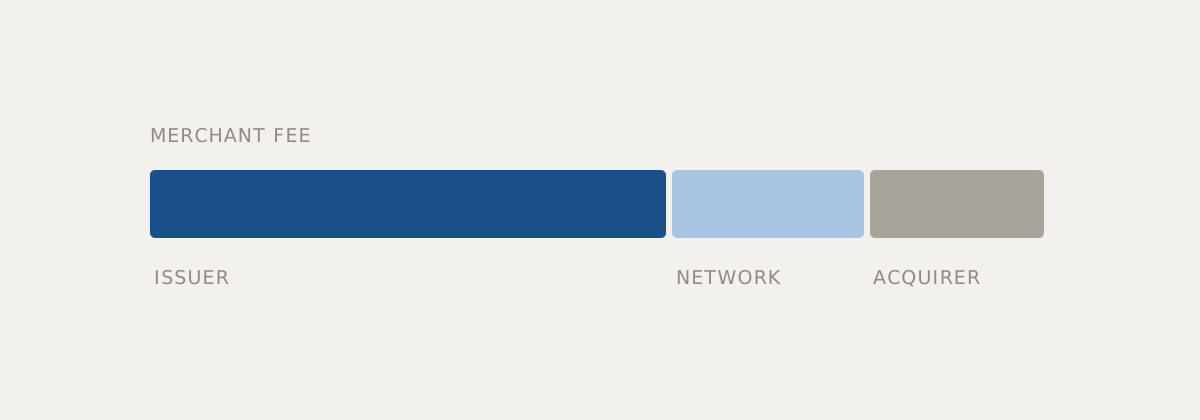
Interchange goes to issuers and is set by networks. Scheme or assessment fees go to the networks themselves and have grown steadily, including a proliferation of behavioural fees for authorization attempts, declines, disputes, cross-border flags, and tokenisation. Acquirer markup goes to the processor and is the only negotiable slice.
Under blended pricing, all three are averaged into one rate, and the merchant cannot see the mix. Under interchange-plus, interchange and scheme fees pass through at cost with a disclosed markup. Under interchange-plus-plus, scheme fees are itemised separately too.
Blended pricing is not automatically worse — it can be cheaper for merchants with an unfavourable card mix, and it is operationally simpler. But it makes optimisation invisible. If richer data or better routing lowers your true interchange and your pricing is blended, the saving accrues to your acquirer, not to you. That single fact explains most of the mid-market migration to interchange-plus.
Practical levers, ranked by return
For a team that wants to reduce effective interchange rather than complain about it, the order of operations is fairly consistent.
Get to transparent pricing first. Optimisation without pass-through is charity to your processor.
Fix data submission next. Level 2 and Level 3 data for commercial cards, correct merchant category coding, accurate transaction type indicators for recurring and instalment payments, and complete cardholder verification data. This is engineering work with a directly measurable financial return.
Adopt network tokens and account updater services. Tokenised credentials often qualify for better rates and simultaneously lift authorization rates on recurring billing.
Present promptly and reauthorize deliberately. Late presentment and clumsy reauthorization silently downgrade transactions.
Then, and only then, look at method mix. Offering bank-based rails, local wallets, or account-to-account payments alongside cards changes the blended cost of acceptance — but only if customers actually use them. A cheaper method that converts worse is an expensive method.
Consider surcharging or steering where legal, understanding that it trades cost against conversion and brand perception. In markets where it is normalised it works well. Where it is not, it reads as hostility.
The direction of travel
Three forces are reshaping interchange economics simultaneously.
Regulators keep extending scrutiny, increasingly toward scheme fees rather than interchange alone, on the reasonable observation that capping one component while leaving another uncapped invites substitution.
Account-to-account rails — Pix in Brazil, UPI in India, open banking payments in Europe — are demonstrating that high-volume retail payments can run at a fraction of card economics when a regulator or central bank builds the rail. Where these have scaled, card interchange has become a competitive variable rather than a fixed cost of doing business.
And issuers are diversifying away from interchange dependence toward lending margin, subscription fees, and data products, anticipating that the regulated component of their revenue will keep shrinking.
The system will not collapse. But the era in which interchange was an unquestioned constant is ending, and merchants who treat it as a managed cost rather than a fixed one are already capturing the difference.