Buy Now Pay Later Meets the Credit Cycle
Consumer Credit · January 12, 2026 · 9 min read
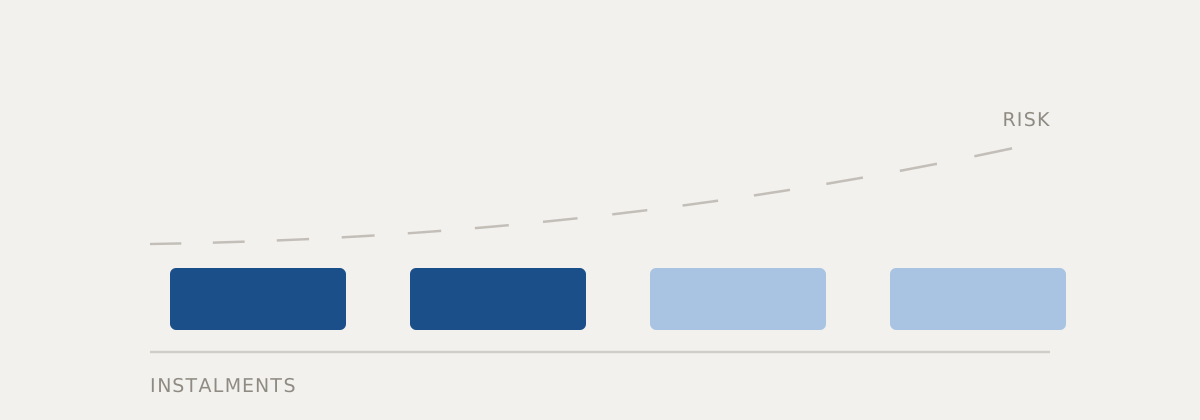
Buy Now Pay Later did something genuinely clever. It took instalment credit — one of the oldest financial products in existence — stripped out the application form, hid the underwriting behind a single tap, moved the cost to the merchant, and placed it at the exact moment of purchase intent. Conversion improved, basket sizes grew, and adoption was extraordinarily fast.
It also grew up almost entirely during a period of very cheap funding, rising consumer savings, and unusually low delinquency. Those conditions have changed, and BNPL is now being tested on the fundamentals that the growth years allowed it to defer.
The two products called BNPL
Conflating them is the most common analytical mistake.
Pay-in-four is a short-term instalment product, typically four payments over six weeks, interest-free to the consumer, funded by a merchant fee of roughly two to eight percent depending on category and negotiation. The consumer pays nothing unless they pay late. Underwriting is thin and fast, relying on soft signals and internal repayment history rather than full credit assessment.
Longer-term instalment financing covers three, six, twelve, or twenty-four month plans, often interest-bearing, for higher-ticket purchases. This is closer to conventional point-of-sale lending, with fuller underwriting and interest income as the primary revenue source.
They have different customers, different risk profiles, different regulatory treatment, and different economics. The regulatory scrutiny has largely focused on pay-in-four, because that is the product that avoided consumer credit rules by virtue of being short-term and interest-free.
Why merchants pay for it
Merchant willingness to pay several times card interchange requires explanation, and the answer is measurable.
BNPL demonstrably increases conversion at checkout, particularly on mid-ticket items where the full price triggers hesitation. It increases average order value, because a smaller apparent payment expands what feels affordable. And in some categories it brings incremental customers who would not have purchased at all.
The BNPL provider also assumes credit risk and fraud risk on the transaction, which has genuine value: the merchant is paid in full upfront regardless of whether the consumer completes their instalments.
The critical question for any merchant is whether the lift is incremental or cannibalising. If a customer who would have paid by card instead uses BNPL, the merchant has paid a much higher fee for the same sale. Sophisticated merchants measure this with holdout tests rather than accepting provider-supplied attribution, and the answers vary substantially by category. Where genuine incrementality exists, the fee is easily justified. Where it does not, BNPL is an expensive payment method with a good sales pitch.
The unit economics under pressure
BNPL revenue per transaction is thin, and the cost structure has three components that all moved unfavourably.
Funding cost. BNPL providers borrow to fund receivables. When base rates were near zero, funding a six-week receivable cost almost nothing. As rates rose, funding became a material cost against a fixed merchant fee — and unlike a credit card issuer earning interest, a pay-in-four provider cannot pass rate increases to the consumer. This compressed margins mechanically, with no operational failure required.
Credit losses. Loss rates on pay-in-four rose from the exceptionally low levels of the early period. Some of this was cohort maturation, some was normalisation from pandemic-era consumer strength, and some reflected the natural consequence of rapid growth: expanding a lending book quickly almost always means lending to progressively weaker credits.
Customer acquisition and operations. The land grab for merchant partnerships and consumer app installs was expensive, and servicing, collections, and dispute handling scale with volume.
The strategic responses have been consistent across the sector: tighten approval rates, push into interest-bearing longer-term products where the consumer bears the funding cost, build genuine consumer-side revenue through cards and shopping apps, and pursue scale to spread fixed costs. Several providers acquired banking licences or bank partnerships specifically to access deposit funding, which is cheaper and stickier than wholesale markets.
Regulation arrives
BNPL’s original regulatory position rested on exemptions written for a different world — short-term, interest-free credit was largely carved out of consumer credit regimes. Regulators have closed that gap in most major markets.
The United Kingdom moved toward bringing BNPL into the regulated consumer credit perimeter, with affordability assessment requirements, information disclosure standards, and access to the financial ombudsman for complaints.
The European Union revised its consumer credit framework to explicitly include short-term interest-free credit, extending creditworthiness assessment and disclosure obligations.
In the United States, regulators asserted that certain BNPL products carry credit-card-like dispute and refund rights, and pressed on data harvesting practices and the absence of standardised disclosures.
Australia brought BNPL under its credit licensing regime with proportionate obligations.
The substantive requirements cluster around four themes: real affordability assessment rather than fraud screening dressed as underwriting; clear disclosure of costs and consequences of missed payments; dispute and refund rights comparable to cards; and credit bureau reporting.
That last item may be the most consequential of all. BNPL’s most-cited systemic risk was invisibility — a consumer could hold plans with several providers simultaneously, and none of them, nor any bank assessing that consumer, could see the total. Bureau reporting fixes the information gap. It also means BNPL usage begins affecting consumers’ credit files, which changes consumer behaviour in ways the industry has not fully absorbed.
The consumer picture
Evidence on consumer outcomes is more mixed than either advocates or critics present.
BNPL is used disproportionately by younger consumers and by those with thinner credit files or less access to conventional revolving credit. For a consumer who repays on schedule, pay-in-four is genuinely cheaper than carrying a credit card balance — interest-free instalments beat revolving interest, straightforwardly.
The concerns are about the tail. Consumers holding multiple simultaneous plans can lose track of aggregate obligations. Late fees, while individually small, are regressive in effect. Some research associates heavy BNPL use with broader financial stress indicators, though disentangling cause from correlation is genuinely difficult — financially stretched consumers seek flexible credit, which is not the same as flexible credit causing the stretch.
The defensible position is that BNPL is a reasonable product with real consumer benefit that requires the same guardrails as any other credit product: assess affordability, disclose clearly, report to bureaux, and handle hardship properly. Which is broadly what regulators concluded.
What to watch
Several indicators will determine how this settles.
Loss rates through a genuine downturn. BNPL’s underwriting models have not been tested by a real employment shock. The thesis that transaction-level behavioural data underwrites better than traditional bureau scores is plausible and largely unproven under stress.
Funding structure. Providers with deposit funding or bank ownership have a durable cost advantage over those dependent on wholesale markets. This alone may determine the eventual market structure.
Merchant fee sustainability. As BNPL becomes an expected checkout option rather than a conversion advantage, merchant willingness to pay a premium erodes. A payment method that everyone offers confers no competitive edge, and pricing follows.
Card network integration. Networks have built instalment capabilities directly into card rails, letting issuers offer plan-based repayment on existing cards. This attacks BNPL’s differentiation using infrastructure that already reaches every merchant.
Consolidation. Thin margins and high fixed costs favour scale. The number of independent BNPL providers is likely to keep falling through acquisition and exit.
BNPL is not a bubble and it is not the future of all credit. It is instalment lending with excellent distribution and a novel fee structure, now being repriced for a normal interest rate environment and brought inside the regulatory perimeter it initially sat outside. The providers that survive will look considerably more like lenders and considerably less like growth-stage software companies — which is what they always were underneath.